Click the translucent pill (blue dot marks it) or the big Copy button.
What’s Zero-Width Space?
The zero‑width space (U+200B) is a Unicode glyph that renders nothing and occupies zero width. In the right hands, this “invisible ink” changes how software treats text.
Example
Below are seven tricks I actually use, each with a quick demo.
Anchor an Alphabetical List
Prefix one or more ZWS characters to push an item ahead of "A".
Newsletter ← with ZWS
Apple
Zucchini
Break Auto‑Linking
Drop a ZWS into a URL or email to foil scrapers while leaving it human‑readable.
hello@starikov.co
https://starikov.co
Duplicate C++ Identifiers
ZWS is a valid identifier char in many compilers.
int total = 1; // normal
int total = 2; // looks the same, compiles fine
std::cout << total + total; // prints 3
Python Indentation Gremlins
Slip a ZWS into leading spaces; code looks aligned but crashes.
def hello():
print("ok") # four spaces
print("boom") # four + ZWS → IndentationError
Hide Easter‑Egg Text
Insert a binary watermark every 100 chars; humans never see it, diff tools do.
Zero‑Length Social Forms
Some platforms allow a username, bios, and other forms that is literally just ZWS. Pure minimalism.
Control word‑wrapping
Add ZWS inside a super‑long URL to let browsers break the line without inserting a visible hyphen.
GoodTherapy — RSS Evidence‑informed articles on mental‑health practices and therapeutic approaches.
Stronger by Science — RSS Strength‑training research translated into practical coaching recommendations.
The Gottman Institute — RSS Relationship insights grounded in decades of psychological research.
Interest(ing)⌚️💼
Atlas Obscura — RSS Reports on unusual places, histories and cultural phenomena worldwide.
BOOOOOOOM! — RSS Contemporary art, illustration and photography features with international scope.
Europe By Rail — RSS Practical guidance and commentary on rail travel across the European continent.
Field Notes — RSS Dispatches on paper goods, analogue tools and design‑focused manufacturing.
I Love Typography — RSS Articles exploring type design, font history and typographic trends.
Naturally Ella — RSS Vegetarian recipes highlighting seasonal produce and whole foods.
Rands in Repose — RSS Essays on engineering leadership, organisational culture and personal productivity.
Wait But Why — RSS Long‑form explorations of technology, psychology and existential questions.
zen habits — RSS Minimalist practices aimed at simplifying work, health and daily routines.
News🗞️
NATO — RSS Official statements, operational updates and policy briefings from the alliance.
ProPublica — RSS Investigative journalism focused on accountability in public and private sectors.
The White House — RSS Executive‑branch announcements, speeches and policy documents.
United Nations — RSS Global news and humanitarian updates from UN agencies and missions.
Economist A weekly newspaper‑magazine renowned for its dry wit and data‑rich, liberal‑minded analysis of global politics, economics, business, science and culture.
Over the past year, I've become quite invested in Wordle. Actually, Taylor and her family started playing first, and I quickly joined in. Soon enough, I even got my mom hooked on it!
If you're not familiar, Wordle is an engaging daily puzzle where you have six tries to guess a secret five-letter word, guided by helpful color-coded hints.
Throughout the year, I consistently chose the same starter: SLATE.
SLATE
It felt safe and reliable—I always knew my next steps based on it. However, Taylor experimented with different starters and consistently crushed it.
This made me curious: what are actually the best starting words? After some digging, familiar contenders: CRANE, SLATE, TRACE, CRATE, CARET. I've compiled a comprehensive list below for (both of our) future reference.
CRANE SLATE TRACE CRATE CARET
Identifying the Optimal Starters
Rather than relying solely on intuition or AI, I wanted to see if a straightforward, "old-school" program could crack this puzzle. First, we needed a suitable dictionary of words. Unix and macOS provide the standard words library, but this includes obscure entries that Wordle may not recognize.
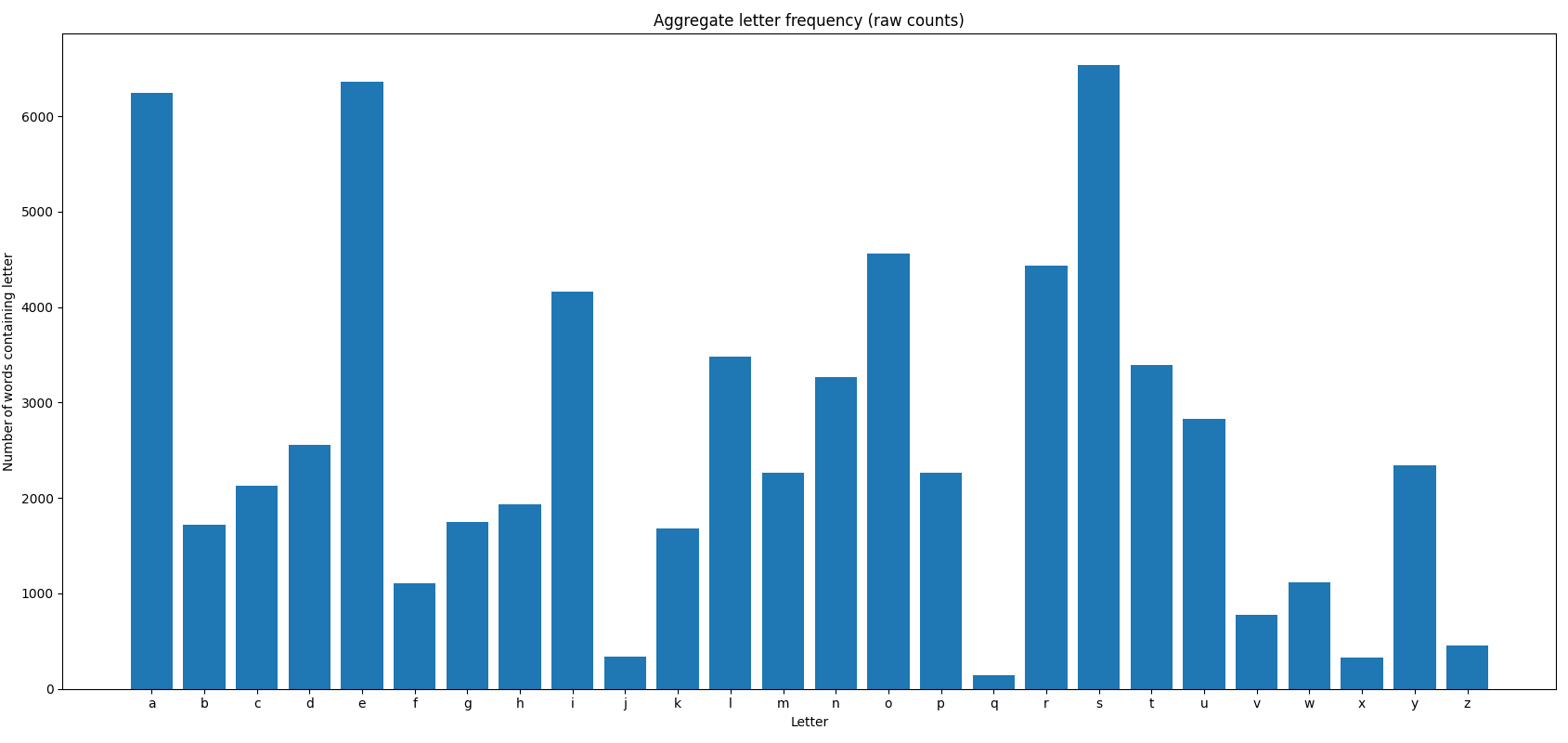
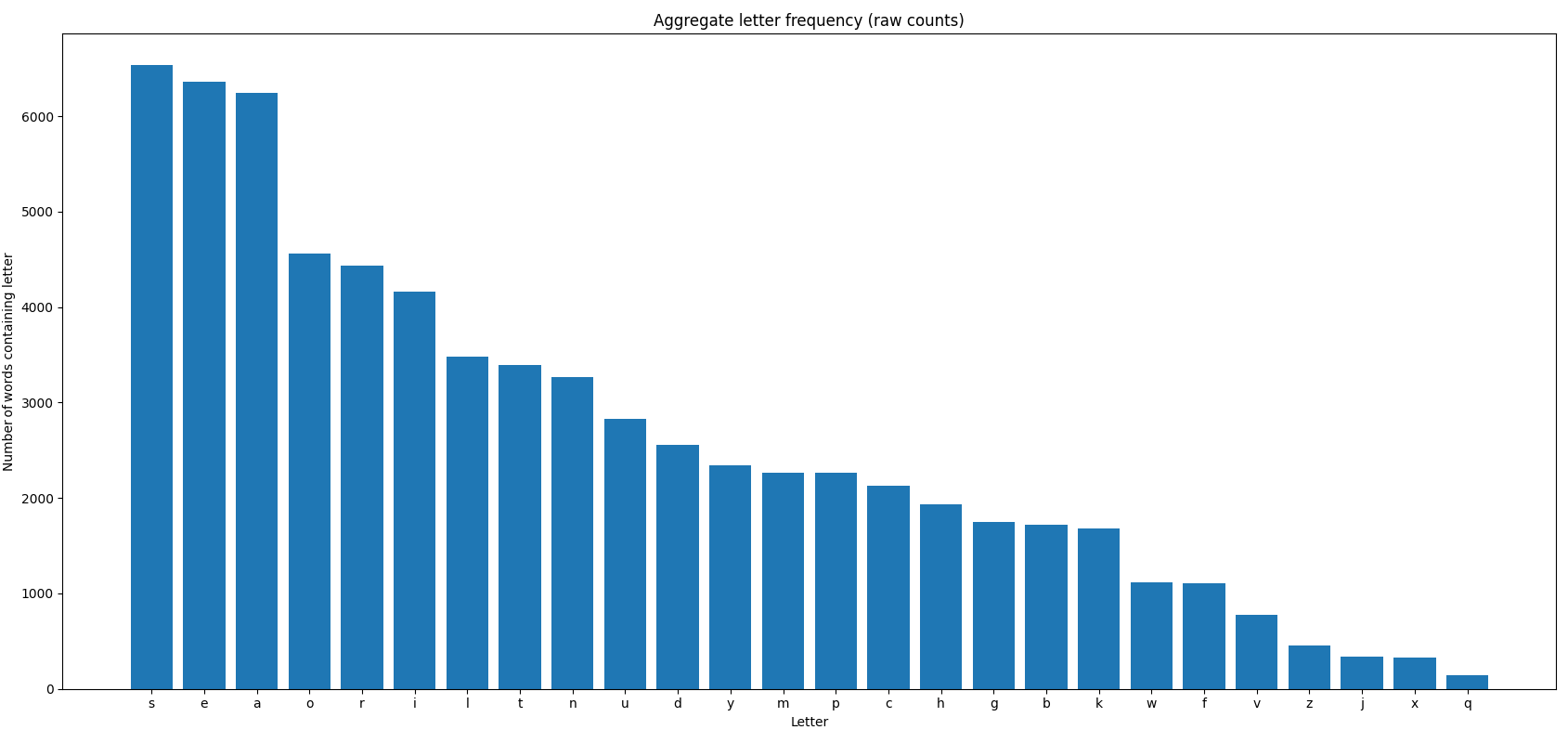
Next, we required an effective scoring method. A straightforward approach is to calculate letter frequency across all words—the more frequently a letter appears, the higher its score.
Quickly, some letters emerged as particularly common:
Most frequent: S, E, A
Moderately frequent: O, R, I
Interestingly, four of these letters are vowels: E, A, O, I.
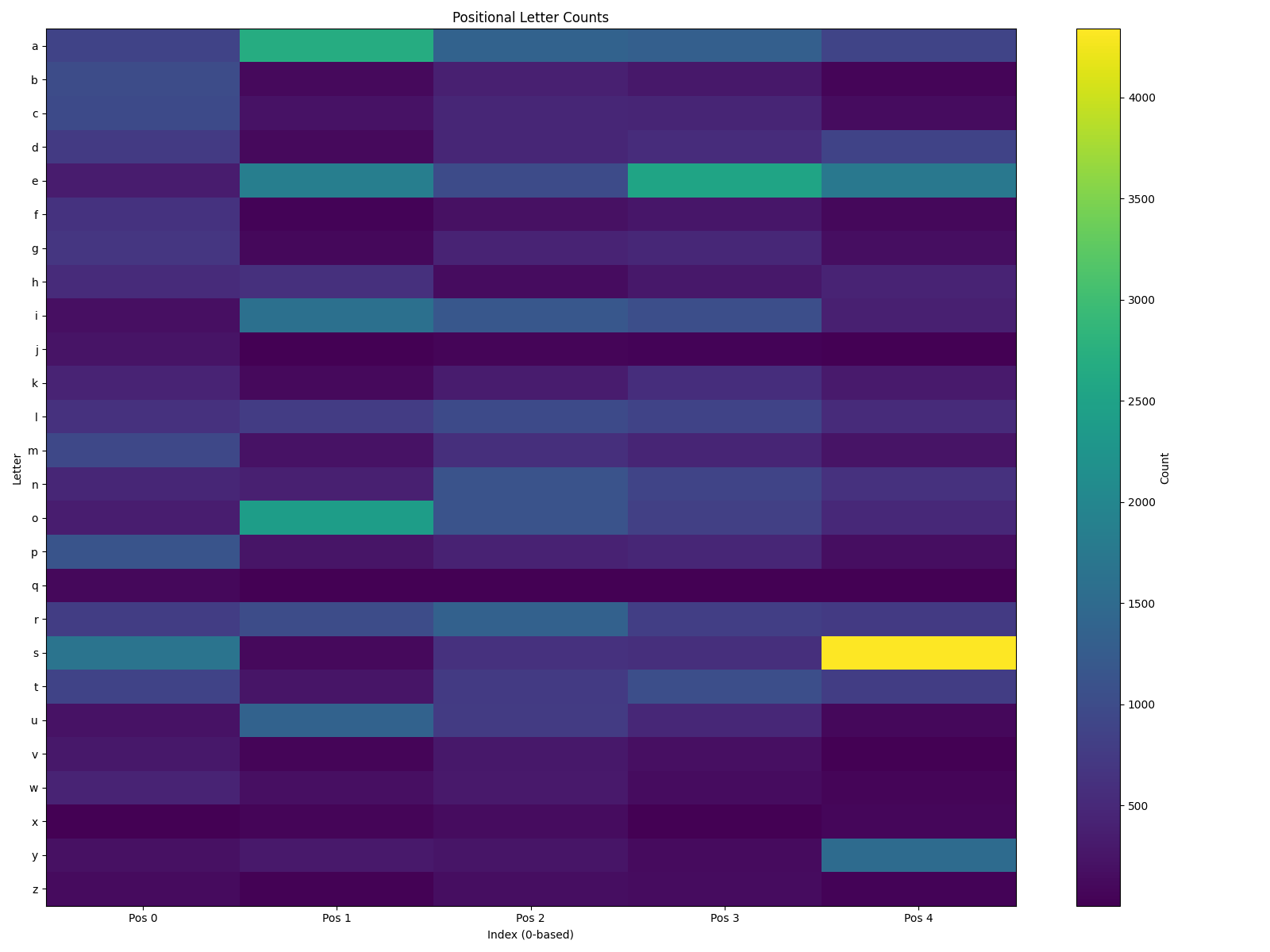
Positional frequency matters too—letters are scored higher if they're common in specific positions within words.
Notably:
The {S, 4} combination (a trailing "S") dominates, suggesting many plurals.
{S, 4}: ____S
Other frequent positional letters:
{A, 1}: _A___
{E, 1}: _E___
{E, 3}: ___E_
{I, 1}: _I___
{O, 1}: _O___
{S, 0}: S____
{T, 0}: T____
{U, 1}: _U___
{Y, 4}: ____Y
Finally, by combining aggregate letter frequency and positional data, a hybrid scoring system emerged. This method offers a more balanced and nuanced approach, producing unique top words: AEROS, SOARE, REAIS, AROSE, and RAISE.
AEROS SOARE REAIS AROSE RAISE
Even when you feed my script the same 2,309‑word official Wordle answer list that WordleBot uses, our rankings still diverge because of how we each value information: my hybrid metric simply adds up how frequently each letter—and, to a lesser degree (10 % blend), each letter‑in‑position—appears across all answers, then zeroes out any word with duplicate letters on turn one, so high‑coverage vowel‑heavy options like AEROS and SOARE dominate; WordleBot, by contrast, runs a full entropy simulation for every guess and keeps duplicate letters if they shrink the remaining solution space, which is why consonant‑balanced staples like CRANE and SLATE top its chart. In short, we share the same dictionary; the gulf comes from aggregate‑frequency math versus entropy‑driven feedback simulation, plus my harsh repeat‑letter penalty and modest positional weight.
Parting Thoughts
Choosing the ideal Wordle starter is about balancing letter frequency and positional insights. Popular starters like CRANE and SLATE remain consistently strong choices due to their strategic letter placement and high-frequency letters. Meanwhile, hybrid scoring systems, which blend multiple metrics, offer compelling alternatives like SOARE and AEROS, maximizing initial guess effectiveness.
Whether sticking with tried-and-true favorites or exploring data-driven options, the real fun of Wordle lies in its daily puzzle-solving and the friends and family your spend doing it with.
My Words
The words generated by my program rank first by a hybrid metric (10% blend), then positional, then aggregate letter frequencies. The metrics are calculated by a sum of the letter’s value, with the value equaling the number of letter occurrences / total words. Positional does the same over the individual positions.
Word
Hybrid #
Hybrid
Position #
Position
Aggregate #
Aggregate
AEROS
1
0.98841
1
1.89498
SOARE
2
0.98324
3
1.89498
REAIS
3
0.97544
7
1.86772
AROSE
4
0.97213
2
1.89498
RAISE
5
0.96532
6
1.86772
SERIA
6
0.96462
9
1.86772
SERAI
7
0.96366
8
1.86772
LARES
8
0.96129
19
0.77624
17
1.82195
RALES
9
0.96041
20
1.82195
TARES
10
0.95962
6
0.79354
ARISE
11
0.95871
5
1.86772
ALOES
12
0.95772
10
1.83063
AESIR
13
0.95761
4
1.86772
RATES
14
0.95669
TOEAS
15
0.95635
13
1.82518
ARLES
16
0.95380
14
1.82195
RANES
17
0.95379
23
0.77186
41
1.80754
NARES
18
0.95341
29
0.76567
40
1.80754
EARLS
19
0.95316
15
1.82195
LAERS
20
0.95265
16
1.82195
REALS
21
0.95174
21
1.82195
TERAS
22
0.95116
37
1.81649
LEARS
23
0.95079
19
1.82195
TEARS
24
0.94912
35
1.81649
AEONS
25
0.94816
PARES
1
0.81023
BARES
2
0.80168
CARES
3
0.79946
MARES
4
0.79818
90
1.74042
PANES
5
0.79441
PORES
7
0.79219
BANES
8
0.78586
PALES
9
0.78458
BORES
10
0.78364
CANES
11
0.78364
DARES
12
0.78364
60
1.75988
MANES
13
0.78236
CORES
14
0.78142
GARES
15
0.78028
MORES
16
0.78014
FARES
17
0.77765
PONES
18
0.77637
BALES
20
0.77604
TORES
21
0.77550
MALES
22
0.77253
HARES
24
0.76998
PATES
25
0.76856
ALOSE
11
1.83063
STOAE
12
1.82518
LASER
18
1.82195
SERAL
22
1.82195
ARETS
23
1.81649
ASTER
24
1.81649
EARST
25
1.81649
Top Words
Top recommended words based on expert analysis. Check mark ✓ applies to words that have been Wordle words before.
Evil Maposaurus prepare to meet your doom. Our hero has the power, glovebox is your tomb. Grab your Garmin take on the world.
The year is 2007: the iPhone launches, The Sopranos series finale airs, and Britney Spears may or may not have hair. It’s Super Bowl XLI — the Chicago Bears vs. the Indianapolis Colts. It’s the first Super Bowl played in the rain, and we’re heading into halftime with the Bears only down by two. Sadly, they would never recover. And the world would never recover from one of the greatest commercials of all time.
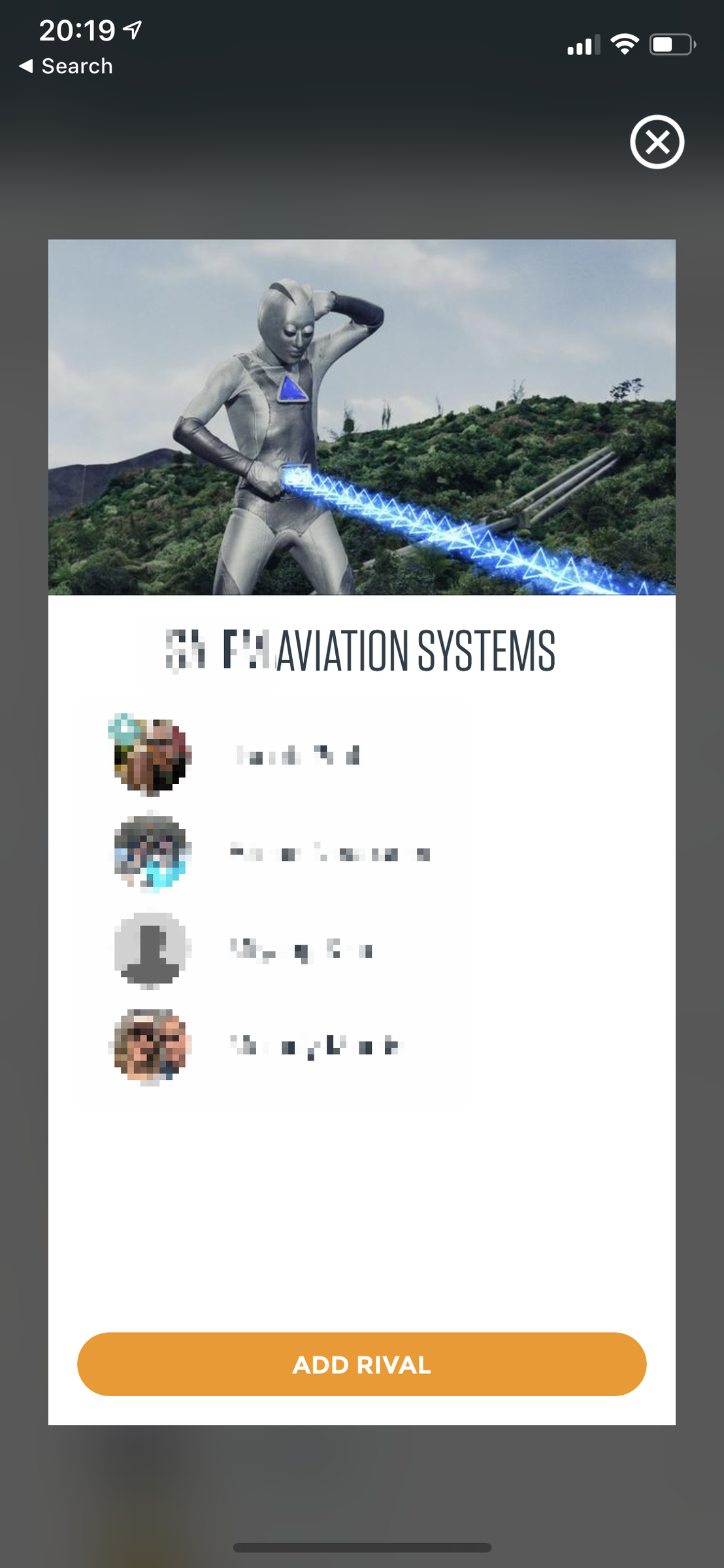
I’m talking about Maposaurus. A tongue-in-cheek homage to Ultraman, this commercial featured a befuddled driver fumbling with a giant paper map — remember those? — which bursts into life as a rampaging "Maposaurus" monster. A passerby pulls out his Garmin in-car GPS unit — remember those? — and, in true Ultraman fashion, transforms into a laser-shooting hero and defeats the beast. There’s even a sick rock soundtrack to go with it.
Evil Maposaurus, prepare to meet your doom. Our hero has the power, glovebox is your tomb. Grab your Garmin, take on the world. Grab your Garmin, every boy and girl. GPS, power, space, and truth. MP3, traffic alerts, Bluetooth. The champion of personal navigation. Garmin.
This commercial would go on to receive critical acclaim — and how couldn’t it?
Garmin returned the next year with another clever concept: Napoleon. Racing a red sports car through modern-day Paris, he relies on his trusty Garmin to guide him to battle. When the car screeches to a halt at its destination, Napoleon leaps out expecting war glory — only to be met by his troops presenting him with a small white pony instead of an army. I guess the joke is: even history’s greatest general can’t tell where he is without GPS.
While Napoleon didn’t receive quite the same praise as Maposaurus, both ads are emblematic of Garmin’s cultural moment — the undisputed leader in in-car navigation. When I told people I worked at Garmin, the #1 response I got was: “The car GPS thing?” Another industry, turned into an app on your home screen.
I first saw Maposaurus during my second internship at Garmin, thanks to my then-mentor Alex. I carried that lore with me into my first full-time job the next year. When it came time for the annual corporate walking/step challenge, I already had the perfect team name: Maposaurus. Then I walked like the glovebox depended on it.
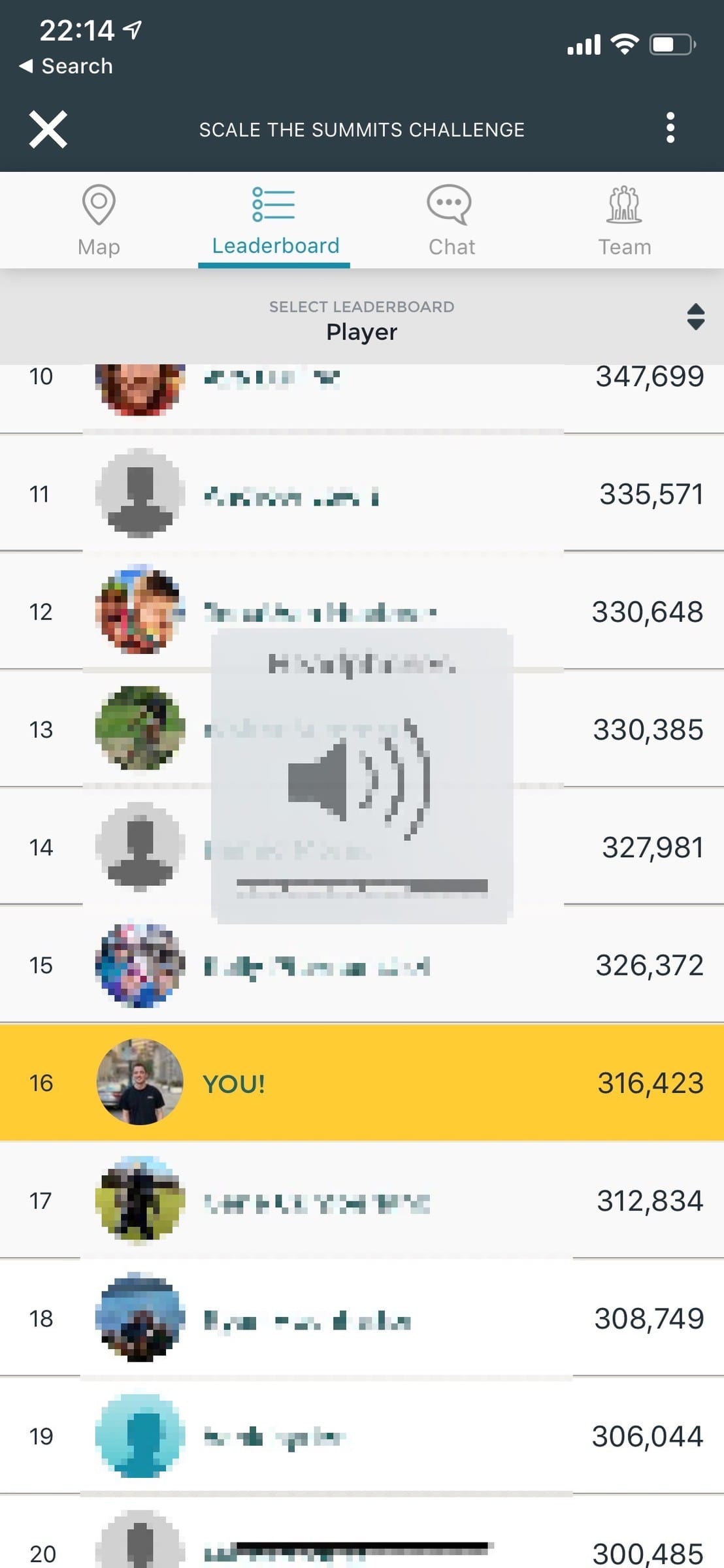
Maposaurus finished top 5 of more than 40 teams, and I came in #16 out of 200+ individuals on a leaderboard that clocked me at 316,423 steps. My own Health app, counting every step, says 327,010 across those 18 days, February 18 to March 7, 2019. The day-by-day:
327,010steps · 18 days
#16of 200+ walkers
24,974best single day
19,579best week · per day
Daily steps, every day of the challenge · February 18–March 7, 2019Average steps per day, by week · I kept it up for eight straight weeks
The official tally, for the record:
By the end of the competition, others were inspired — and even copied our headers!
The best part: it wasn't just a contest-week spike. I averaged over 17,000 steps a day across the eight weeks from mid-February to mid-April.
Orange is the sky’s way of smiling before it says goodnight.
Today, Bodie turns a whopping 14 years old. We took him into our home in January 2023 from Taylor’s parents, and these two years have been filled with nothing but love, paw prints on my face at 3 a.m., and many servings of sous-vide fine meats. Today, he’s getting steak tips.
Bodie's first day in his new home
First off, he’s doing great considering his hyperthyroidism. He was diagnosed about two years ago, and typically cats have a life expectancy of 1–3 years after diagnosis. But as you can see from the photos, he’s looking mighty healthy. Just like in everything else he does, I know he’ll far outlive expectations.
These days, he has many hobbies:
Going outside. He’s loving the California sun — and the blessed lack of mosquitoes. He enjoys it so much that he tries to sneak out now. He succeeded once, and the taste of freedom hooked him. He loves rummaging through bushes, rolling in the dirt, and getting pets from everyone in the neighborhood.
Sous-vide or pressure-cooked chicken and beef. With hyperthyroidism, he needs an ample supply of food. Cats can’t have seasoning or oils, and while they can eat raw meat, we prefer cooking it to reduce the risk of bacteria in store-bought cuts. That rules out the skillet (too sticky), and while boiling works, would you eat boiled meat? If he’s not getting wet food, he needs all the moisture he can get from what he eats. So now I sous-vide the meats, or Taylor pressure-cooks them.
Heating pads. It gets cold here at night, so we set out a heating blanket for him on low with a timer. Or he’ll just sleep on one of us — whichever’s closer.
Cat wheel. We got it for Mallory to exercise on, but neither of them really used it for that. Bodie does love kneading it, though!
Obsessing over shoes. I’d rather not get into this one...
Screaming in the middle of the night. He doesn’t want to come to you — he wants you to come to him. Whether he’s bored, hungry, or lonely, you can count on a raspy meow echoing through the darkness.
Bodie scream
0:00
/17.1
All in all, he lives a good life, despite the odds. He has arthritis in his paws, so he buckles every now and then. He sits and watches the world with calm detachment, occasionally blessing it with a slow blink. He’s taught me the virtues of patience, the joy of companionship, and the beauty of routines that don’t need any words.
I look forward to many more moments curled up in sunlight, many more screams at the bottom of the stairs for food, and — hopefully — no more surprise escapes.