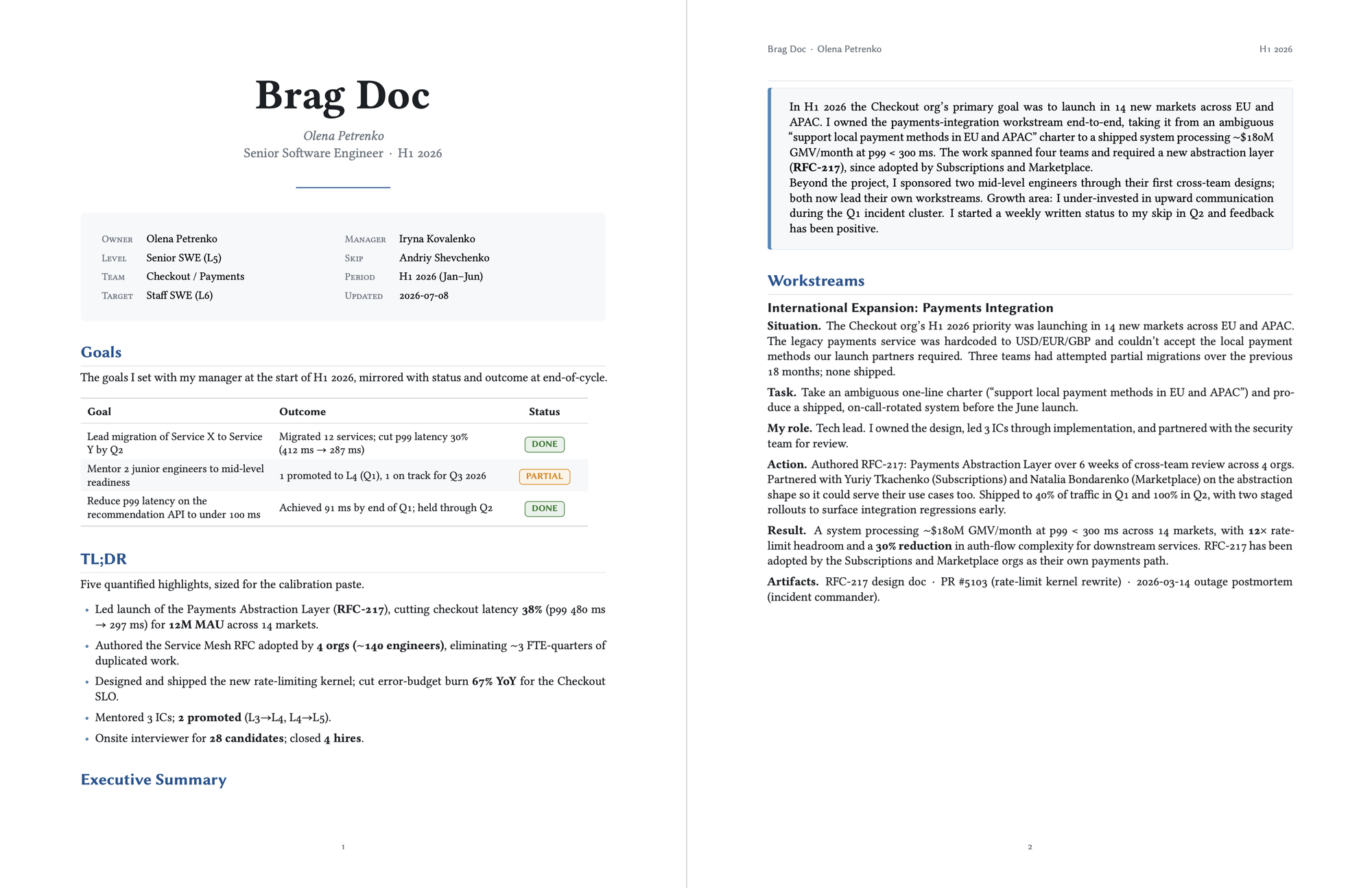
Brag Doc Template
A simple template for tracking your engineering impact across a performance cycle.
Copy this file, fill in your own content. Update the Quarterly logs once a month. Promote items into the upper sections every 2-4 weeks. At review time, you trim and reorder. Don't write from scratch.
Metadata
| Field | Value |
|---|---|
| Owner | Your name |
| Level | e.g., Senior SWE (L5) |
| Period | e.g., H2 2025 |
| Manager | Name |
| Last updated | YYYY-MM-DD |
Goals
The 2-5 goals you set with your manager at the start of the cycle. Mirror them at the end with a status and one-line outcome.
| Goal | Status | Outcome |
|---|---|---|
| Lead the migration of Service X to Service Y by Q3 | 🟢 Done | Migrated 12 services; cut p99 latency 30% |
| Mentor 2 junior engineers to mid-level readiness | 🟡 Partial | 1 promoted, 1 in progress |
🟢 done · 🟡 partial · 🔴 missed · ⚪️ deprioritized
TL;DR
3-7 bullets, each one quantified. Lead with the biggest thing. This is what your manager pastes into calibration.
- Led launch of, cutting checkout latency 38% (p99 480ms → 297ms) for 12M MAU.
- Authored the Service Mesh RFC adopted by 4 orgs (~140 engineers), eliminating ~3 FTE-quarters of duplicated work.
- Designed and shipped the new rate-limiting kernel; cut error budget burn 67% YoY.
- Mentored 3 ICs; 2 promoted (L3→L4, L4→L5).
- Onsite interviewer for 28 candidates; closed 4 hires.
Executive Summary
One to three short paragraphs. What was the team trying to do, what was your role in it, what's different because you were there.
In H2 2025 the Checkout org's primary goal was to launch in 14 new markets. I owned the payments-integration workstream end-to-end, taking it from an ambiguous "support local payment methods in EU and APAC" charter to a shipped system processing ~$180M GMV/month at p99 < 300ms. The work spanned four teams and required a new abstraction layer (RFC-217), since adopted by Subscriptions and Marketplace.
Beyond the project, I sponsored two mid-level engineers through their first cross-team designs; both now lead their own workstreams. Growth area: I under-invested in upward communication during the Q3 incident cluster. I've started a weekly written status to my skip in Q4 and feedback has been positive.
Workstreams
One subsection per major project. Use STAR: Situation, Task, Action, Result. 3-5 per cycle is typical. Fewer reads as low impact. More reads as scattered.
[Outcome-shaped title, e.g., "Made international expansion possible"]
- Situation. What problem existed before you started? Quantify the pain.
- Task. What you were asked, or what you decided, to do.
- My role. Sole engineer / TL with 4 ICs / co-lead with @alice / reviewer & sponsor of @bob's work. Honest attribution makes your real contribution legible.
- Action. 3-6 things you did. Decisions you made and why. Trade-offs you owned. Partners (PM, design, data) you worked with.
- Result. Numbers. Adoption. Behavior change.
- Artifacts. Links to design docs, PRs, launches, dashboards, postmortems.
Repeat the block above for each major workstream.
Artifacts
Direct links. Reviewers cross-reference these. Keep it skim-able.
- Design docs / RFCs. Title: one line on impact
- Significant PRs. Title: one line on impact
- Talks / posts. Title: venue, audience size
- Incidents / on-call. e.g., IC for 3 sev-2s; 8 shifts; ~24 pages
- Hiring. Loops: 28 · Hires closed: 4 · Bar-raiser: 12
- Above and beyond. Open-source, internal community work, DEI, conference talks
Peer Reviewers
Who can speak to which work. Share this section with them so they know what to comment on.
| Reviewer | Relationship | What they can speak to |
|---|---|---|
| @alice | Cross-team peer | RFC-217 review, payments collab |
| @bob | Direct mentee | Mentorship effectiveness |
| @carol | Sister-team TL | Cross-team alignment, incident response |
Growth
The section reviewers trust most. Name real things. "I should communicate more" is not a growth area.
What I got better at. e.g., Writing strategy docs that get traction outside my org. 0 → 3 adopted RFCs.
What I missed or got wrong. e.g., Q3 incident cluster: I under-communicated to skip-level for ~2 weeks. Course-corrected with a weekly written status; feedback positive in Q4.
Where I want feedback. e.g., Am I operating at the L6 bar on technical scope? Where am I still acting like a Senior IC instead of a Staff IC?
Quarterly Log
The raw material. Update once a month; one entry per quarter. Promote items upward every 2-4 weeks.
Template entry
## YYYY Qn

- Shipped:   [Major PRs, launches, decisions this quarter]
- Designed:  [RFCs, docs, proposals]
- Helped:    [Mentees, unblocks, sponsored work]
- Incidents: [On-call shifts, sev levels, what I learned]
- Decisions: [Strategic decisions that landed]
- Quotes:    [Positive feedback received this quarter]
- Lessons:   [Honest notes; private to you]
- Metrics:   [Dashboard movement traceable to me]
Example entry
## 2025 Q4

- Shipped:   RFC-217 (payments abstraction) reached 100% rollout
             Rate-limit kernel to 100% (canary started Q3)
             Onboarded @marketplace onto the new auth flow
- Designed:  RFC-217 v3 published; reviews from 4 orgs
             RFC-218 (Service Mesh follow-on) draft circulated
- Helped:    Co-authored @alice's L3 → L4 promo packet
             Sponsored @bob's first cross-team design review
             Unblocked @marketplace on auth migration (3 × 40min)
- Incidents: IC for 2 sev-2s (Oct 14, Nov 2); 12 pages total
             Cut false-positive rate 60% via alert config
- Decisions: Deferred Project Zeta to H1 (~6 eng-weeks saved)
             Pushed back on premature dual-write; saved a quarter
- Quotes:    @director on RFC-217: "clearest doc this quarter"
             @skip on RFC-218: "exactly the right altitude"
- Lessons:   4-day meeting series that should've been a doc;
             next time, propose async first
- Metrics:   p99 checkout 312ms → 297ms (post-canary)
             Build time 41min → 17min (CI parallelization)
             Error budget burn 4.2× SLO → 1.4× SLO YoY