Begin a Brag Doc
Document the narrative before someone else drafts it.
NOTE 📜 This is a post about Software Engineering. All views are my own and do not represent my employer. Please review my Disclosures.
📄 Brag Doc Template The structure below, as copy-paste-ready markdown.
📋 My Brag Doc The personal version: NBA arenas, gym PRs, concerts.
When I entered tech, I assumed my manager knew everything I was working on. I gave status at weekly standups. We went deep in our one-on-ones. I figured he was keeping track.
He was, but humans don't work that way. A manager runs a 6-12 person team. They hold the big picture: the major milestones, the big PRs, the design docs that landed. The rest fades fast, and compacts with every new cycle.
This is why you should keep a brag doc. A brag doc is a running log of your impact: wins, artifacts, metrics, growth. You own it. You maintain it. It's ready when you need it.
There are plenty of other reasons have one:
- Memory is unreliable. Both yours and your manager's. By the time calibration happens, Q1 work has been buried under three quarters of newer fires.
- Promotion packets need scaffolding. You can't synthesize 12 months of work into a 500-word write-up the night before. You need raw material.
- Calibration is comparative. Your skip-level is in a room comparing you against four other engineers. Specificity wins.
- Job changes happen. The doc you keep for promotion is the same doc you grab when a recruiter pings you about a senior role.
- Leadership rotation. Your manager rotates. So does your skip, your director, your VP. Each new chain inherits a thin model of your work, and only you can fill it in.
Brag Evolution
Initially, I communicated my achievements once a performance cycle: through the write-up. You know the one. List five achievements from the last 12 months. Or list the projects you worked on and explain their outcomes. My manager would read it and form a judgement. This was fine, for a while.
It's hard to craft a narrative in the format of the performance review. You have to explain the high level and go into gritty details, all inside a word limit. By the time you've explained the project, you have 100 words left for the impact. By the time you've made the impact case, the section is over. You cherry-pick the wins you can summarize in two sentences, not the wins that mattered most.
Around every performance review, my manager was surprised by all I had accomplished. This is actually not a good sign. It meant my manager had a thin view of what I was doing for most of the year. I needed to change that.
Then came time for my first promotion. I had to shape two years of work into a coherent case. I pored over old performance reviews, gathered everything into one doc, and updated it for the newest wins. It was a lot of work. Hence this meme:

The system was unsustainable.
Then came the brag doc. Thirty minutes the last Friday of each month. A few bullets, minimum. When the next perf review came around, I copied the relevant rows into the form. When the next promotion came around, the doc was already most of the packet. The mad scramble never came back.
Philosophy
Over the years of maintaining a brag doc, I have gotten quite opinionated on them. I thought they should:
Know your audience. This document isn't for you, it's for your management chain. Imagine your manager in a review session and they need to quickly justify your contributions: you need structure and hierarchy. Or you're a senior leader reviewing this document to determine promotion: you need a story and a vision. Write your document for them, not you.
Focus on impact, not contributions. I've tried a lot this cycle, some things landed resoundingly, some things landed poorly. You don't need to omit your missteps, because this proves your work was challenging. Instead, you need to focus on your most impactful work and how you got there.
Write as you go. A doc you compile two weeks before review is fragmentary at best. The doc you maintain weekly stays grounded in real artifacts: PRs you actually shipped, meetings you actually ran, bugs you actually closed.
Quantify ruthlessly. "Improved performance" is forgettable. "Cut p99 latency from 280ms to 95ms across a rollout to 1M users" is not.
Tie work to scope. Every entry should answer: what changed, who benefited, and at what scope. Without scope, "fixed a bug" reads identical to "led a multi-team migration."
And, because we live in the AI era, one last principle:
Make it AI friendly. Maintaining the doc is grunt work. Point an AI at your raw materials and it writes most of this for you. You handle the craft, curation, and story. The AI handles the toil.
Doc Template
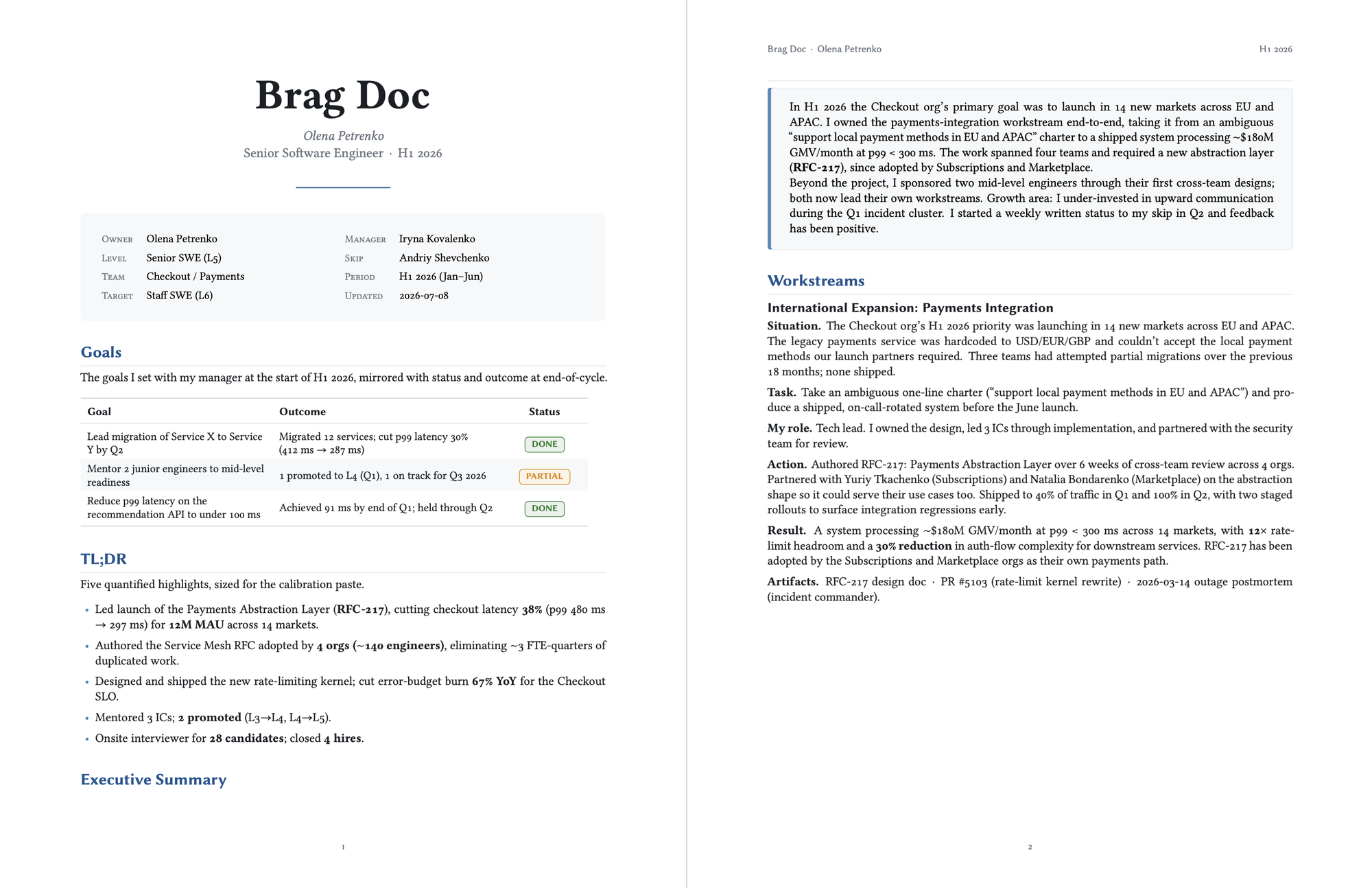
Owning the doc lets you control the narrative: what gets surfaced, how, and to whom. The alternative is leaving it to memory.
Goals
You've probably already set these with your manager. If you're already tracking goals elsewhere, paste them in verbatim. If not, write down what you and your manager agreed to in your last planning conversation.
Examples:
- Lead the migration of the user-auth subsystem from Service A to Service B by Q3.
- Onboard and ramp two new mid-level engineers to independent contribution.
- Reduce p99 latency on the recommendation API to under 100ms.
TL;DR
Bullet points of the big landings throughout the year. Punchy, data-driven, memorable. Reads like a cross between a stats sheet and a press kit.
What metrics back up your goals? Did you conduct interviews? Host an intern? Cover a broad set of data points and go deep on a few.
Examples:
- Shipped the auth migration on the Q3 date, zero customer-facing regressions.
- Cut p99 from 280ms to 91ms; backed by load-test results and a week of post-rollout monitoring.
- Authored 4 design docs, reviewed 31, mentored 2 new engineers to independent contribution.
- Closed 47 bugs, including 3 sev-2 production incidents.
Executive Summary
The overview of your cycle, written for skim-readers. Picture an outsider or a senior leader with a few paragraphs of attention: what do they need to know?
Example:
This year I focused on three workstreams: the auth migration, latency reduction, and team growth. The auth migration shipped on time and unblocked the broader platform refactor. Latency work brought us within SLO for the first time in 18 months. I also onboarded two new engineers, and now formally mentor one of them.
Workstreams
This is the meat. For each major workstream you contributed to, write 2-4 paragraphs covering: the problem, the approach you took, the outcome, and your specific contribution. Be honest about scope. If you were one of five engineers, say so. If you led the design and three others implemented, say that.
I usually have 3-5 core workstreams per cycle. Anything fewer reads as low impact. Anything more reads as scattered.
Example:
Auth Migration. Service A had been our auth provider since 2019, but its rate-limiting story didn't scale to our new mobile clients. I led the design, partnered with the security team for review, and shipped the migration to 40% of traffic in Q2 and 100% in Q3. Net result: 12x rate-limit headroom and a 30% reduction in auth-flow complexity for downstream services.
Artifacts
Now that you laid out your case, you need data to support it. You proved the quality of your work; now it's time to prove the quantity.
Here, I post everything:
- Documents especially design docs
- Pull Requests not just core work, but rollbacks, bug fixes (even if the bug is in your code), any sort of code contributions
- Tickets you've closed with highly-visible ones (i.e., high number of comments) at the top
- Meetings such as alignment sessions, peer programming, or presentations you've done
- Awards from your peers or your management chain
The point isn't to pad the section. Calibration discussions often pivot on a specific artifact you forgot to mention. Better to have it listed and unused than missing and decisive.
Peer Reviewers
Who did you work with? In what domains? What were their contributions? Your manager will ask all three when reading your writeup. The list isn't only so they can ask others about your work; it also helps level you. If you're level N working with N+1 and N+2 reviewers who vouch for you, that's a strong promotion signal.
This list, along with your brag doc, is one of the few levers you have during this process. So make it solid. Talk with your reviewers before the cycle; ask if they have feedback for you.
Growth
The section reviewers trust most. A self-aware gap analysis signals seniority better than any single win. Name real things; vague "I should communicate more" reads as filler.
Three sub-sections cover it:
- What you got better at. Specific skills, with evidence.
- What you missed or got wrong. Concrete misses, with what you'd do differently.
- Where you want feedback. Direct questions your reviewers can answer.
Example:
What I missed. Q3 incident cluster: I under-communicated to skip-level for ~2 weeks. Course-corrected with a weekly written status; feedback positive in Q4.
Quarterly Log
The raw material that feeds everything above. One entry per quarter, accumulated monthly. Each entry is a structured set of bullets: shipped, designed, helped, incidents, decisions, quotes, lessons, metrics.
This section is the most important and the most unglamorous. The Workstreams, TL;DR, and Executive Summary all draw from it. If you maintain nothing else, maintain this. By the end of the year, you'll have a year of evidence ready to be cherry-picked.
Example slice from a Q4 entry:
- Shipped:   RFC-217 reached 100% rollout
- Decisions: Deferred Project Zeta to H1 (~6 eng-weeks)
- Metrics:   p99 checkout 312ms → 297ms (post-canary)
Your Own Brag Doc
This inspired me to publish my own brag doc, of sorts. I took the things I'd done outside of work: every NBA arena I've visited, every concert I attended, every gym PR. Same idea as the work brag doc, just for the parts of life that don't have a perf review.
You can read mine here.
Whichever version you keep, personal or work or both, start it today. Open a doc, paste in three things you did this week, and don't stop. The version you'll have in 6 months is the one you'll wish you had today. Write it once a month, cash it once a year.