iPhone (17?) Air, One Month Later
I fear I am about to feel what iPhone Mini people feel.
A confession. After reading the announcements, I planned to upgrade from my iPhone 16 Pro Max to iPhone 17 Pro Max. It was a luxury move, with my less-than-full-day battery life as the polite excuse. By the time I went to preorder, my configuration was weeks out. So I bought iPhone Air instead, in my usual configuration: the newest color (Sky Blue), 512 GB.
This is my 9th iPhone. My favorite, until now, was iPhone 6 Plus. Despite its size, the comfort was unmatched. I kept it for three years, my longest streak. Every iPhone since has been a strong device; none felt quite like that one.
I'm happy to say the crown has been passed to iPhone Air.
The Air feels every bit as comfortable as phones used to feel, with 2025 internals inside. I had assumed I needed to step down from the Max line because my hand cramped during bedtime use. The issue wasn't size, though; it was the close cousin of size: weight.
Below is a chart of every iPhone's weight. Peaks are Pro Maxes, valleys are base models, color-coded by year. The base iPhone 15 weighs as much as a Pro from several years ago.
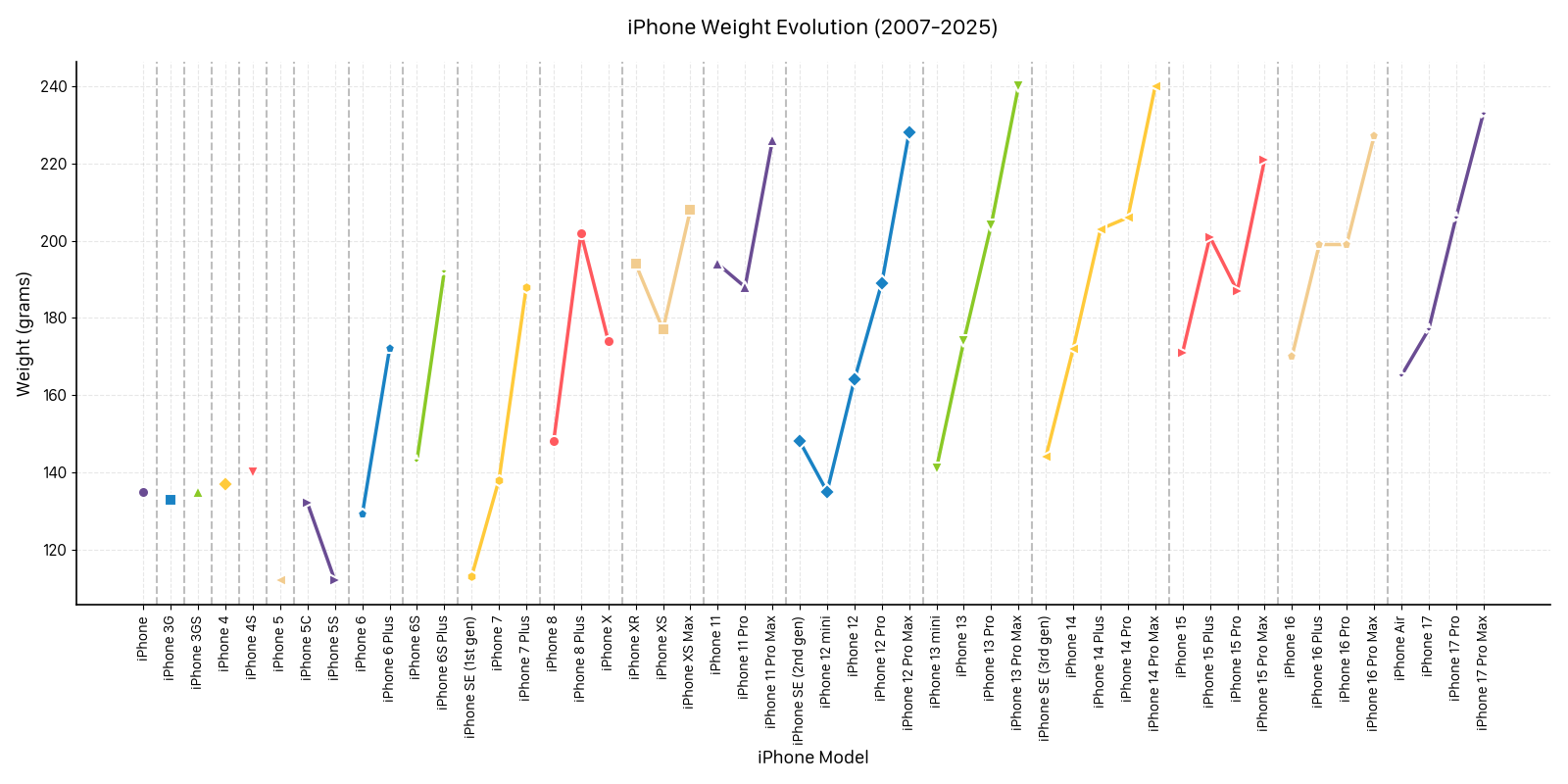
The trend is unlikely to reverse. Customers have consistently asked for more battery, better cameras, and louder speakers, and those upgrades come with mass. To make the Air, Apple chose a different point on the curve:
- Battery: 3,149 mAh (vs. 3,692 mAh on base, 4,252 mAh on Pro, 5,088 mAh on Pro Max)
- Camera: single rear lens, no telephoto or ultra-wide
- Speaker: mono via the earpiece. The bottom-firing driver is omitted.
These are the trade-offs the spec sheet shows. On paper, the Air reads like a phone of compromises. So why, after a month, am I keeping mine?
Because the spec sheet isn't how I use a phone.
My partner has an iPhone 12 Mini. Every time I pick it up, I think "too small for me." When I pick up the Pro Max, the weight asks for two hands or a surface; one-handed use is unstable. For my hand, the Pro line is comfortable for long sessions only with a case. The base iPhone hasn't fit my hand the way I'd hoped.
The Air is comfortable regardless of hand size. The screen is large enough to text on one-handed. It sits in a pocket without sagging. It's the first phone I've used caseless without immediately scratching it, a habit I'd given up after my iPhone 12 Pro's front glass cracked under normal wear.
I gave it a month before writing, to live with each trade-off:
- "Hard to pick up off a table": easy unless it's face-down.
- "Too thin to hold": most comfortable phone I've held, for my hands.
- Single camera: I reposition or hand the phone to my partner more often.
- Mono speaker: noticeable in showers and noisy kitchens; unnoticeable elsewhere because I'm usually wearing AirPods.
- Battery: real-world use requires charger logistics, but I'd been doing that since iPhone 8. Many owners online report battery comparable to iPhone 16 Pro in normal use.
Each trade-off is real. None mattered enough to undo the comfort gain.
I handed the phone to my partner, who has called every iPhone and Pixel I've passed her "heavy" or "huge," and she said, "wow, this is nice." Six years of feedback to the contrary, then one sentence the other way. That was the moment I was certain.
A few design choices, from a customer's perspective, where I think there's room to improve:
- Pricing. $999 puts Air $200 above the base and only $100 below the Pro. Many buyers will close that small gap to the Pro for the feature delta.
- Color palette. Sky Blue, Light Gold, Cloud White, Space Black: subtle and minimal. The palette reads as aspirational, which positions the phone as a niche device rather than mass-market.
- Marketing emphasis. Air's messaging leans on thinness. From my experience, the meaningful win is weight, not thickness, and weight is a more legible benefit to a casual buyer.
- Visibility. I haven't seen Air ads on billboards, TV, or in my online feeds. The phone has lived primarily on Apple's own surfaces.
Reports suggest Air's sales came in below targets, with some pushback on those numbers. Apple has discontinued past "fourth iPhone" experiments (Mini, Plus, SE), and Air may follow.
After a month, two conclusions:
- I'll wait for the next iteration of Air, unless it takes more than three years (the same patience I gave iPhone 6 Plus).
- I'll buy whatever Apple ships as the successor. One more camera, the second speaker, and that's enough.
A thought experiment: rotating a different "fourth slot" each year (Air, Fold, Mini) would let Apple test new form factors without committing to multi-year roadmaps. Not free, since separate molds and supply chains have real cost, but a way to keep the lineup varied for a small population of customers who care.
For now, iPhone Air is the phone I reach for. The first iPhone in a long time that I genuinely enjoy holding: quiet, unobtrusive, content to disappear into my pocket and stay out of my way until I need it.





%20Air%2C%20One%20Month%20Later)